Email Automation Software: Compare Triggers, Segmentation, Integrations, and Pricing
Select the right email automation software by comparing triggers, segmentation, integrations, and pricing—discover what truly drives successful campaigns today.
When you’re choosing email automation software, it’s important to evaluate how triggers, segmentation, integrations, and pricing will impact your campaigns. Each feature shapes how well you can connect with your audience and streamline your workflow. But not all platforms handle these aspects equally, and picking the wrong one can slow your growth. Understanding what really matters can help you make smarter decisions—so where should you start?
What to Look for in Email Automation Software
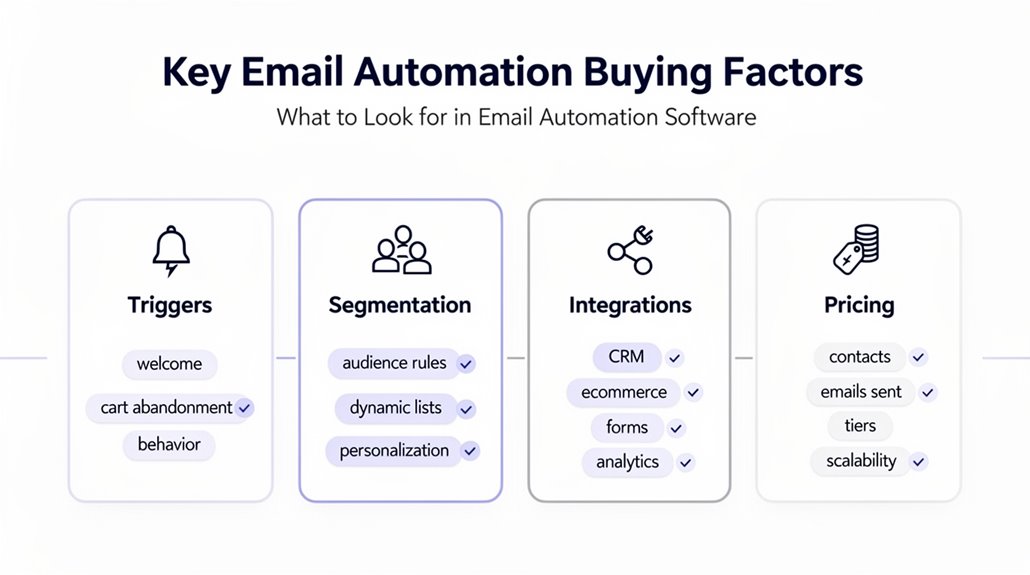
What should you focus on when choosing email automation software? First, look for automation depth that supports complex workflows, allowing for branching paths based on subscriber behavior. This flexibility enables you to craft highly personalized campaigns tailored to individual actions. Advanced segmentation is essential, too, letting you update audiences in real time and target specific customer groups effectively. Verify that the software integrates seamlessly with your existing CRM software and other marketing tools to keep your data synchronized and operations smooth. A/B testing capabilities are important; choose a platform that lets you experiment with various content elements—not just subject lines—to optimize engagement. Don’t forget to evaluate pricing structures carefully. Whether the fees depend on contact count, send volume, or tiered plans, you want a solution that scales cost-effectively as your list grows. Prioritizing these features guarantees your email automation software meets your needs without compromising functionality or budget. Additionally, consider that higher pricing tiers typically unlock advanced automation and integration options, making them worthwhile investments as your campaigns grow in complexity.
Using Email Automation Triggers to Streamline Campaigns
You can set email automation triggers based on actions like signups, purchases, or cart abandonment to send timely, relevant messages. Behavior-based automation helps you segment your audience and personalize campaigns for better engagement. Using these triggers streamlines your workflow and boosts the effectiveness of your marketing efforts. Platforms like Klaviyo and Drip also offer pre-built automation templates for common campaigns, making it easier to launch effective sequences without extensive technical knowledge.
Common Trigger Types
How can email automation triggers make your campaigns more effective? By leveraging common trigger types like sign-ups, website interactions, cart abandonment, and purchase confirmations, you can send automated emails tailored to your audience’s actions. Behavioral triggers use customer data to enhance personalization and drive deeper engagement by responding to browsing habits or past purchases. Segmentation plays a vital role here, letting you create targeted groups based on these triggers for more relevant messaging. With advanced automation, you can implement conditional logic to adapt emails to each user’s journey, maximizing impact. Incorporating time-sensitive actions with timestamp-based triggers guarantees your emails arrive at the perfect moment, boosting response rates. Using these triggers strategically streamlines your campaigns and strengthens your connection with subscribers.
Behavior-Based Automation
Countless marketers rely on behavior-based automation to deliver timely, relevant emails triggered by specific user actions like website visits, email opens, or purchases. With advanced email automation, you can create automated flows where triggers and actions respond instantly to user behavior, such as sending cart abandonment emails just hours after a shopper leaves items behind. By using segmentation based on user behavior, you tailor personalized email campaigns to different engagement levels, improving your marketing strategies and boosting customer retention. This approach lets you adapt in real time, ensuring your emails stay relevant throughout the customer journey. Behavior-based automation streamlines your campaigns by focusing on individual actions, helping you communicate more effectively and increase conversions through precise, behavior-driven messaging.
Trigger Campaign Benefits
When specific user actions like sign-ups or purchases trigger your emails, your campaigns become instantly more personalized and relevant. Trigger campaigns use behavioral triggers to send timely, targeted follow-up emails that align with user behavior, boosting engagement rates markedly. With advanced automation features, you can recover lost sales through cart abandonment emails or send birthday messages and re-engagement campaigns that nurture customer relationships. This level of personalization helps you streamline your campaigns, reducing manual effort and improving marketing efficiency. By leveraging automated triggers effectively, you not only enhance your customer experience but also see a measurable improvement in ROI. Using trigger campaigns, you’ll create more meaningful interactions that convert, making your email marketing smarter and more impactful overall.
Segmentation Strategies for Better Targeting
Segmentation is a powerful tool that lets you divide your email list based on criteria like demographics, behavior, and purchase history, so your messages feel more personal and relevant. Using effective segmentation strategies, you can leverage advanced segmentation tools to update your lists dynamically, guaranteeing your emails always hit the mark. Behavioral segmentation helps you track user actions for more precise targeting, boosting your click-through rates. By applying audience tagging, you create highly specific groups for sending customized content, directly influencing conversion rates and open rates. Lead scoring(link) helps prioritize sales efforts on the most promising prospects, ensuring your segmentation efforts translate into measurable business outcomes.
Here’s how to improve your targeting with segmentation:
- Use personalized content to increase open rates by tailoring subject lines and offers.
- Employ behavioral segmentation to react to user engagement patterns.
- Implement audience tagging for creating targeted emails that resonate with subscribers.
- Utilize advanced segmentation tools for real-time list updates and dynamic campaigns.
These strategies guarantee every email feels relevant, driving better engagement and results.
Top CRM and E-Commerce Integrations for Email Automation
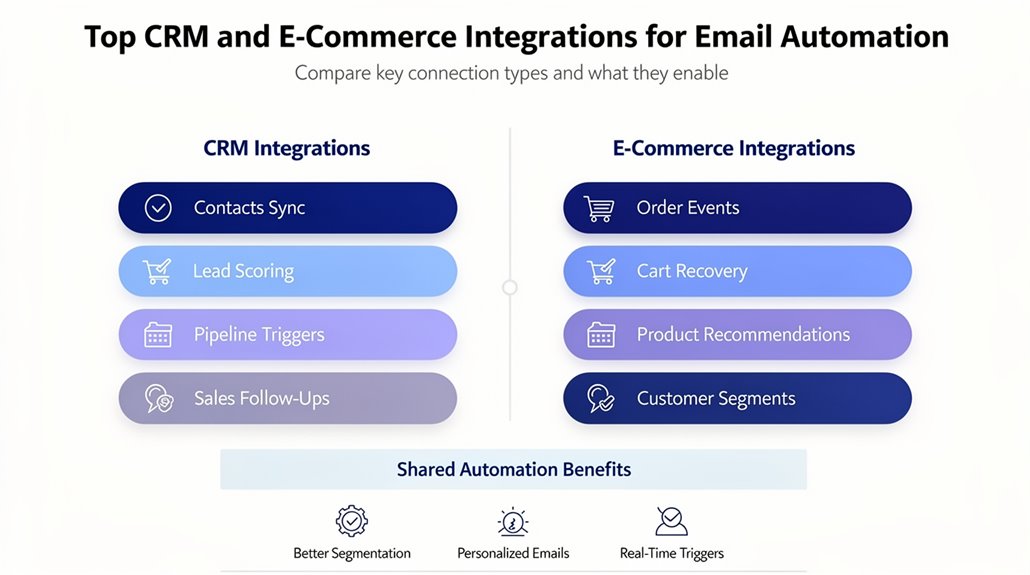
To make the most of your targeted email campaigns, connecting your email automation tools with the right CRM and e-commerce platforms is key. Platforms like Klaviyo and ActiveCampaign offer seamless e-commerce integrations with Shopify and WooCommerce, helping you synchronize customer data for effective segmentation. With CRM integrations such as Salesforce or Zoho, you can leverage rich customer profiles to drive more personalized communication. ActiveCampaign goes a step further by including built-in CRM features that let you manage deals and relationships within the same platform, simplifying your workflow. Brevo also provides multi-channel support, integrating email, SMS, and live chat to boost engagement. These integrations not only improve targeting but also influence pricing structures. Many platforms adopt mid-tier pricing based on contacts or email volume, giving you flexibility as your automation needs grow. Choosing tools with robust integrations guarantees smoother data flow, sharper segmentation, and ultimately, more impactful email automation. When evaluating platforms, it’s worth noting that CRM solutions are generally categorized into four distinct types — operational, analytical, collaborative, and strategic — each serving different business relationship and automation priorities.
Understanding Pricing Structures for Email Automation Software
How much should you expect to pay for email automation software? Pricing structures vary widely based on automation capabilities, subscriber counts, and the features you need. Entry-level plans can start as low as $9/month, offering basic functions and limited sends, while thorough tools with advanced features may exceed $100/month. Many providers include freemium plans or free trials, so you can test before committing.
Keep these budget considerations in mind:
- Freemium plans let you explore core features with limited subscribers.
- Tiered pricing often increases costs as your subscribers and feature needs grow.
- Some platforms price per contact, per send, or per seat, affecting scalability.
- Advanced features and larger subscriber counts generally push you toward higher tiers.
Understanding these variables guarantees you pick software that balances cost with the automation capabilities you require.
Choosing the Best Pricing Plan Based on Your Business Size
When choosing a pricing plan, you’ll want to take into account the size of your business and how quickly you plan to grow. Small businesses might benefit from free or low-cost options that support up to 1,000 subscribers, while scalable plans are better if you expect your contact list to expand. Picking the right plan guarantees you get the features you need without overspending. Platforms like HubSpot offer a free tier for small businesses before scaling into more advanced paid plans as your contact list and automation needs grow.
Small Business Plans
Picking the right email automation plan for your small business means balancing features with your budget and subscriber count. Many providers offer free plans, like Brevo’s 300 emails/day or MailerLite’s 1,000 subscribers, ideal for small businesses just starting. As your customer base grows, pricing adjusts, but you’ll want to take into account segmentation, integrations, and advanced automation carefully.
- Brevo and GetResponse offer budget-friendly free plans with essential features.
- MailerLite provides scalable pricing starting at $39/month after the free tier.
- ActiveCampaign begins at $29/month, focusing on advanced automation.
- Look for plans that customize pricing based on subscriber counts to efficiently manage costs.
Choosing wisely guarantees your email automation fits your needs without stretching your budget.
Scalable Pricing Options
Finding the right email automation plan depends largely on the size of your business and how you expect it to grow. When evaluating scalable pricing options, consider whether free plans like Mailchimp’s or MailerLite’s suit your current needs before upgrading. Platforms like GetResponse offer affordable entry points starting at $19 per month, ideal if you want advanced options without a hefty price tag. ActiveCampaign’s pricing scales with subscriber count, so factor in future growth to avoid surprises. Some automation platforms, like Brevo, use usage-based pricing, charging based on email sends rather than contacts, which can benefit specific businesses. When you look for in email software, focus on flexible pricing that aligns with your growth, ensuring you don’t outgrow your plan too quickly or pay for features you don’t need.
How Email Automation Triggers and Segmentation Boost Engagement
Three key strategies—automation triggers, segmentation, and behavioral insights—can transform your email campaigns by delivering timely, relevant messages that resonate with your audience. Email automation triggers, based on user behaviors and website interactions, let you send targeted emails right when they’re most effective, boosting engagement. Segmentation refines this by grouping subscribers using customer data like demographics and interests, ensuring your messages hit the mark. Leveraging behavioral insights and CRM integrations, you can craft personalized pathways with conditional triggers that speak directly to each subscriber’s needs.
Here’s what you gain by using these strategies:
- Increased open and click-through rates with tailored, relevant content
- More conversions through dynamic, behavior-driven email campaigns
- Enhanced customer loyalty by meeting audience expectations precisely
- Efficient use of CRM integrations for deep segmentation and smarter targeting
Together, these factors elevate engagement and drive meaningful results.
Picking the Right Email Automation Software for Your Goals
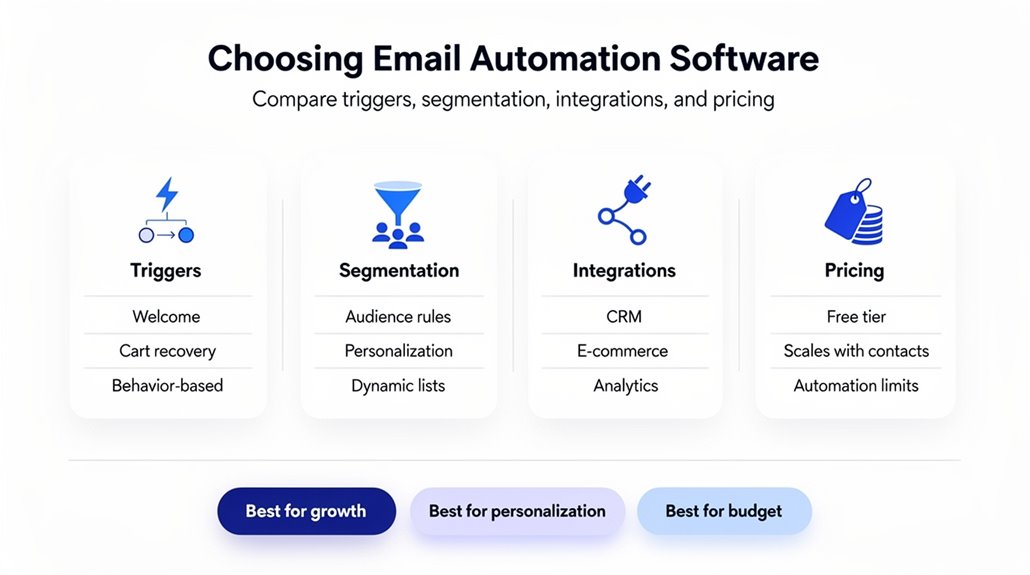
How do you choose the right email automation software to match your specific goals? Start by focusing on behavior-based triggers to send timely, relevant messages—ActiveCampaign, for example, stands out with its visual workflow builder and conditional logic. Next, prioritize segmentation capabilities; robust audience segmentation tools like Klaviyo and Omnisend help target users based on behaviors and interests, boosting engagement. Integration options matter too, especially if you use CRMs or e-commerce platforms; HubSpot’s seamless marketing automation integration guarantees smooth data flow. Don’t overlook pricing structures—Brevo’s send-volume pricing is great if you have a large contact list. Finally, explore analytics and reporting features to track campaign performance; platforms like Mailchimp and ActiveCampaign provide detailed insights to refine your strategy. When comparing marketing automation tools, balancing these factors will help you select email automation software tailored to your needs without wasting resources.
Frequently Asked Questions
What Is the Difference Between Email Automation and Segmentation?
Email automation focuses on setting up email sequences triggered by user behavior to streamline communication and improve lead nurturing. Segmentation, on the other hand, divides your audience into groups based on targeting strategies aligned with campaign goals, enabling content personalization. Together, they amplify automation benefits by increasing customer engagement, optimizing conversions, and providing detailed performance metrics to fine-tune campaigns for better results. You need both for effective conversion optimization.
What Is the 80/20 Rule in Email Marketing?
The 80/20 rule in email marketing means you’ll get 80% of your email engagement from just 20% of your campaigns. You’ll want to focus on personalization techniques, content optimization, and A/B testing to boost open rates and click-through strategies. By honing in on these high-impact areas, you’ll improve campaign performance and subscriber retention, making the most of automation benefits. This approach helps you guide customers effectively through their journey.
What Is the Best Email Automation Software?
The best email automation software for you depends on your needs. ActiveCampaign shines with best features and strong analytics tools, praised in user reviews for ease of use and customer support. Klaviyo scores high on integration options and deliverability rates, especially in e-commerce. Pricing comparison shows Brevo offers affordability, while Mailchimp is great for beginners. Check industry standards and case studies to match software with your goals effectively.
What Is the 60 40 Rule for Email?
The 60/40 rule for email means you should focus 60% of your email strategy on valuable, educational content and 40% on promotional messages. This balance boosts engagement metrics like open rates and click-through, enhancing subscriber retention. When combined with automation benefits, audience targeting, and content personalization, you’ll improve campaign performance while maintaining list hygiene. Sticking to this rule helps you build trust and keeps your emails relevant, increasing your overall success.