
Marketing Automation Platforms Compared: Which One Fits a Lean Marketing Team?
Which marketing automation platform truly suits a lean marketing team’s needs? Discover key features that make all the difference.
Choosing the right marketing automation platform can feel overwhelming, especially when your team wears multiple hats and resources are tight. You need a tool that’s intuitive, flexible, and powerful enough to handle various channels without demanding hours of technical setup. But with so many options promising ease and efficiency, how do you know which one truly fits a lean marketing team’s unique needs? Let’s explore the features that really matter.
Why Generic Automation Tools Don’t Work for Lean Marketing Teams
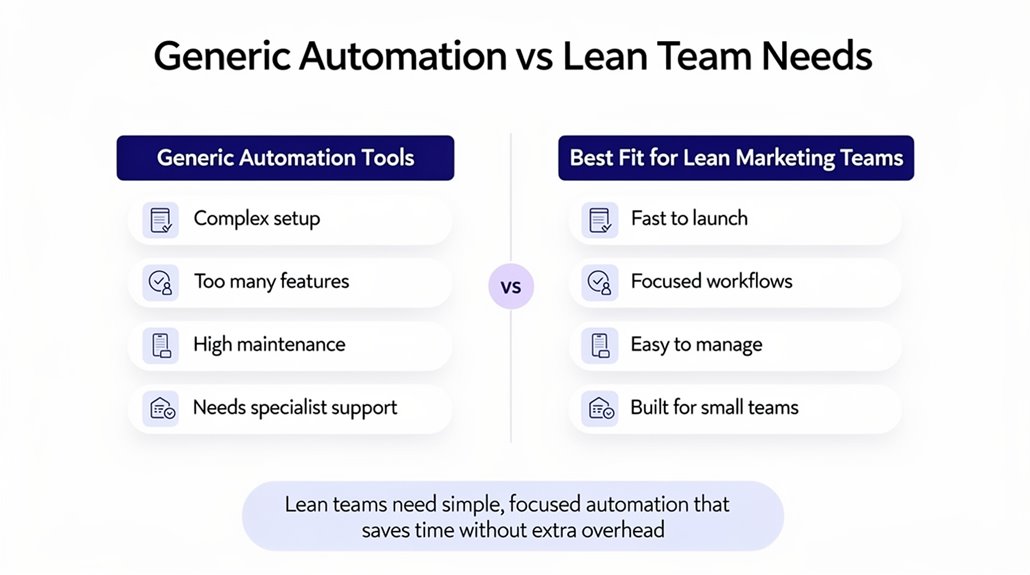
While generic automation tools might seem like a cost-effective choice, they often fall short for lean marketing teams because they lack essential CRM integrations and no-code workflow options. When your marketing automation platform doesn’t seamlessly connect with your CRM, it disrupts data flow, limiting segmentation and personalization. Without no-code workflow capabilities, it’s tough for non-technical members to quickly build and adjust campaigns, slowing down your lean marketing efforts. Many generic tools only focus on email, missing critical multi-channel engagement opportunities that create cohesive customer journeys across channels. Despite their complexity, these platforms often overwhelm small teams, leading to underutilization of their automation capabilities and advanced features. Plus, higher pricing without depth in relevant features drains your budget and hinders efficient resource allocation. Ultimately, generic tools don’t align with the specific needs of lean marketing teams, making it harder to optimize workflows and maximize impact across touchpoints. Tools like ActiveCampaign, HubSpot, and Omnisend are purpose-built alternatives that offer AI-driven predictive content to tailor messages based on customer preferences and behaviors, giving lean teams a meaningful edge in engagement.
Essential Features Small Marketing Teams Need in Automation
For small marketing teams, selecting an automation platform with the right features can make all the difference between smooth operations and constant frustration. You need Marketing Automation Platforms that are easy to use, with user-friendly interfaces to speed up training and adoption. Email automation with AI-driven personalization and ideal send times boosts open rates considerably. Multi-channel engagement through email, SMS, and social media helps increase your customer lifetime value by ensuring consistent messaging. Integration with CRMs simplifies data management, letting you leverage insights for targeting, segmentation, and personalization without extra development work. Automated reporting provides critical metrics to evaluate campaign performance quickly and improve ROI. Tools like Salesforce Einstein and Zoho CRM use predictive analytics and lead scoring to automatically prioritize high-potential prospects, helping lean teams focus their limited resources where conversions are most likely.
| Feature | Benefit |
|---|---|
| User-friendly interfaces | Faster onboarding and higher productivity |
| Multi-channel engagement | Enhanced customer lifetime value and reach |
| Integration with CRMs | Streamlined data for better targeting |
Pricing and Scalability Considerations for Lean Marketing Teams
Choosing the right marketing automation platform means thinking beyond features to how pricing and scalability fit your team’s growth. For lean teams, it’s crucial to select platforms with pricing structures that scale alongside your expanding contact list without hidden costs that could trigger expensive migrations. Entry-level pricing options, like HubSpot’s starter plan at $20/month or ActiveCampaign’s $29/month, provide access to essential features affordably.
Keep total cost of ownership in mind, considering licensing, add-ons, and data usage. Also, evaluate implementation capabilities, since platforms with automated workflows—such as Pendula—can speed up deployment and reduce resource strain. HubSpot’s Professional Plan, for instance, carries a $1,500 onboarding fee on top of its $90/month per-user subscription, which can strain lean team budgets significantly.
To navigate pricing and scalability for lean teams, focus on:
- Transparent pricing structures without hidden costs
- Scalability aligned with growing contact lists
- Total cost of ownership beyond just subscription fees
- Entry-level pricing that fits tight budgets
- Quick implementation with automated workflows for faster ROI
Top Marketing Automation Platforms for Lean Teams: Email, SMS & Multichannel
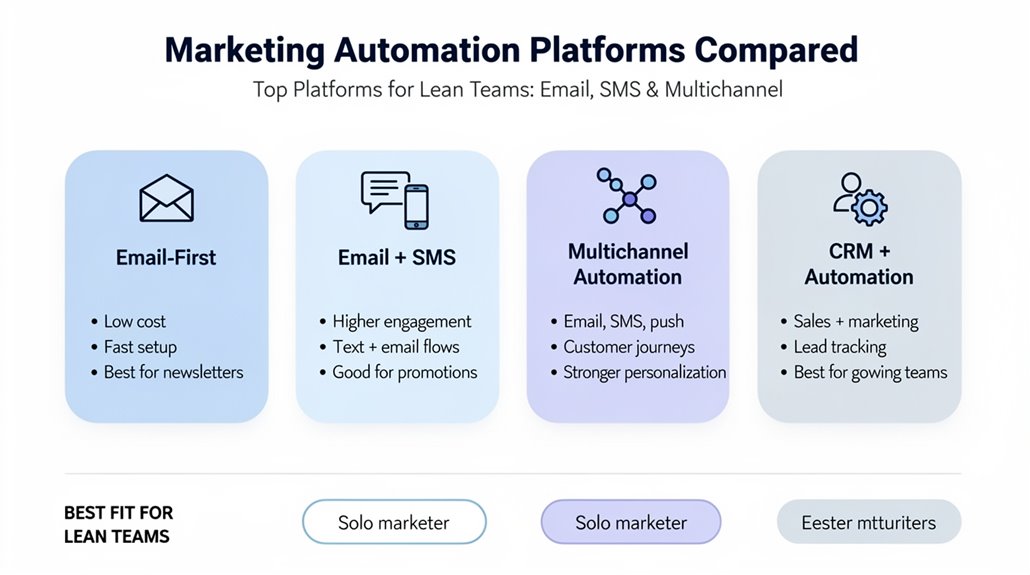
When you’re working with a lean team, choosing platforms that excel in email automation is key to keeping campaigns effective without extra hassle. Integrating SMS and other channels can boost engagement and guarantee your messages reach customers where they are. Platforms with drag-and-drop email builders allow you to design professional campaigns quickly without needing technical skills. Let’s explore some top platforms that balance powerful multichannel tools with ease of use and affordability.
Email Automation Essentials
Although lean teams often face resource constraints, email automation remains an essential starting point, especially with AI-driven tools that optimize send times and subject lines to boost open rates—averaging 21.5% for successful campaigns. Using marketing automation tools like ActiveCampaign, you can create effective automated email campaigns without breaking the bank. Visual workflow builders simplify setting up campaign workflows, making it easier to engage your omnichannel customer base. Tracking performance metrics guarantees you’re constantly optimizing customer engagement. Remember, integrating SMS marketing complements your email efforts for better results.
- Affordable platforms tailored to lean teams
- AI-powered send time and subject line optimization
- Visual workflow tools for intuitive campaign creation
- Focus on performance metrics for continuous improvement
- SMS marketing boosts omnichannel customer engagement
Multichannel Integration Benefits
Multichannel integration is a game-changer for lean marketing teams looking to boost efficiency and results. By combining email, SMS, social media, and web channels into one streamlined workflow, platforms like ActiveCampaign and HubSpot help you deliver a unified customer experience. This omnichannel approach can increase customer lifetime value up to five times compared to single-channel efforts. With AI-enhanced features, you’ll optimize send times and personalization across all touchpoints, driving higher open and click-through rates. Automation for lean teams becomes simple with user-friendly workflow builders that effortlessly coordinate campaigns and consolidate your marketing stack. This means you can maximize impact and adaptability without extra resources, making multichannel integration essential for any lean marketing strategy.
How Integrations Simplify Workflows for Lean Marketing Teams
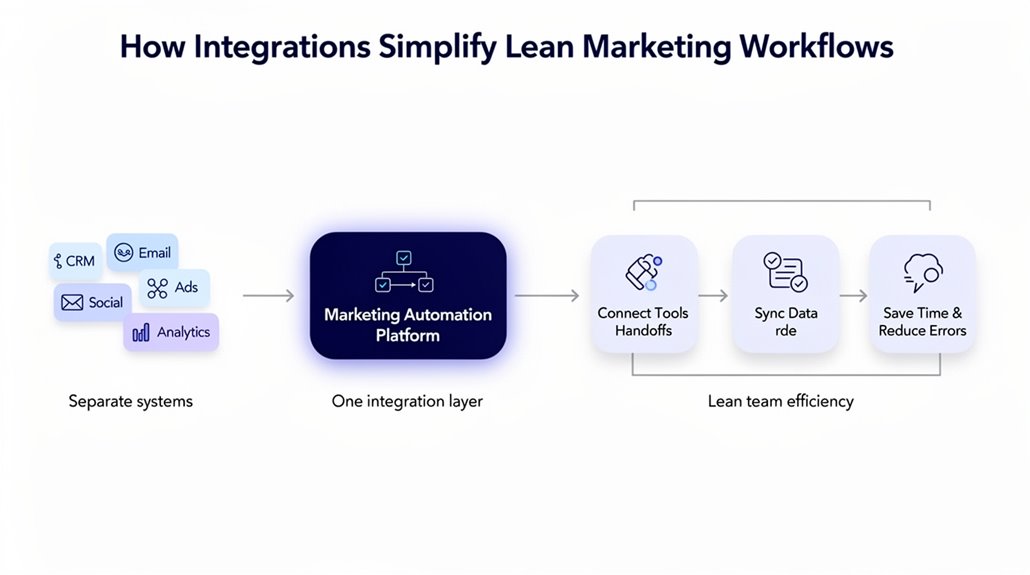
When your marketing automation platform connects seamlessly with your CRM, you get a clear, unified view of customer data without extra effort. This unified access means you can automate workflows more efficiently and avoid manual tasks that slow you down. By streamlining these processes, you’ll boost your team’s productivity and launch campaigns faster. Platforms like HighLevel take this further by consolidating multiple marketing tools into a single platform, reducing the need to juggle separate systems for email, SMS, and social media outreach.
Seamless CRM Connectivity
Three key benefits make seamless CRM connectivity a game-changer for lean marketing teams. Marketing automation software with native CRM integrations simplifies how you manage customer data, ensuring personalized, targeted campaigns without juggling multiple tools. This seamless connectivity enables you to set up automated workflows, improving lead nurturing and boosting conversion rates efficiently.
With this approach, you’ll enjoy:
- Streamlined data flow between CRM and marketing platforms
- Reduced manual processes, freeing up time for strategic initiatives
- Improved lead response times through real-time data syncing
- Customizable workflows via APIs tailored to your team’s needs
- Enhanced accuracy in customer targeting and campaign personalization
Unified Data Access
Unified data access is a game-changer for lean marketing teams, letting you consolidate customer information from multiple platforms without tedious manual entry. A marketing automation solution with strong integrations connects your CRM, CMS, and eCommerce tools, enabling streamlined workflows that save time and minimize errors. You gain real-time data and unified customer profiles across multiple channels, allowing you to launch personalized marketing campaigns quickly and confidently. This unified access removes the hassle of toggling between platforms, boosting your productivity and letting you focus on strategy instead of data wrangling. With well-designed integrations, lean marketing teams can efficiently manage complex campaigns, respond to trends faster, and create more effective marketing efforts—all while keeping workflows smooth and simple.
Automated Workflow Efficiency
Having all your customer data in one place is a great start, but the real power comes from automating how that data moves between your marketing channels. An efficient automation workflow guarantees lean marketing teams can maintain seamless data flow and consistent engagement across customer touchpoints. Integration capabilities simplify connecting email, SMS, social, CRM, and eCommerce platforms, reducing manual work. No-code workflow builders let you quickly create and adjust automated workflows without needing developers, accelerating campaign testing. Plus, AI-driven insights help focus your energy on strategic tasks, boosting efficiency.
Key benefits include:
- Connecting multiple marketing channels effortlessly
- Real-time personalized interactions
- Easy campaign creation with no-code builders
- Smarter resource allocation via AI
- Scalable integrations with open APIs
Balancing Ease of Use With Powerful Automation for Lean Teams
Finding the right marketing automation platform can save you hours by letting you build complex campaigns without needing technical skills or extra support. For lean teams, it’s essential to find tools with a user-friendly campaign builder and no-code workflow features. These guarantee you balance operational complexity with strong features that enhance the customer experience. Platforms like ActiveCampaign and HubSpot excel here, enabling multi-channel automation and quick time to launch.
| Platform | User-Friendliness | Strong Features | Time to Launch (hrs) |
|---|---|---|---|
| HubSpot | High | Extensive | 2-4 |
| ActiveCampaign | High | Thorough | 3-5 |
| Mailchimp | Moderate | Moderate | 4-6 |
| GetResponse | Moderate | Good | 3-6 |
| Sendinblue | High | Good | 2-5 |
Choosing a platform with the right balance helps lean marketing teams automate efficiently without steep learning curves.
Customer Support Must-Haves for Small Teams Without Dedicated Tech Staff
Since small marketing teams often lack dedicated tech support, choosing a platform with reliable, responsive customer service is essential to keep your campaigns running smoothly. Customer support that offers 24/7 technical support means you can resolve issues anytime, maintaining operational efficiency without delays. You’ll want platforms with user-friendly interfaces to reduce the learning curve, helping your team adopt tools quickly. Tailored guidance from a dedicated Customer Success Manager can help you maximize potential by providing personalized support. Extensive onboarding resources guarantee everyone on your team gains proficiency without steep tech demands.
Key customer support must-haves for small teams include:
- 24/7 technical support for instant issue resolution
- Intuitive, user-friendly interfaces to ease adoption
- Tailored guidance to fit your team’s unique needs
- Robust onboarding resources for quick learning
- Fast recovery times to maintain operational efficiency
Focusing on these guarantees your lean marketing team stays productive and supported without extra tech staff.
Which Marketing Automation Platform Best Fits Your Lean Team?
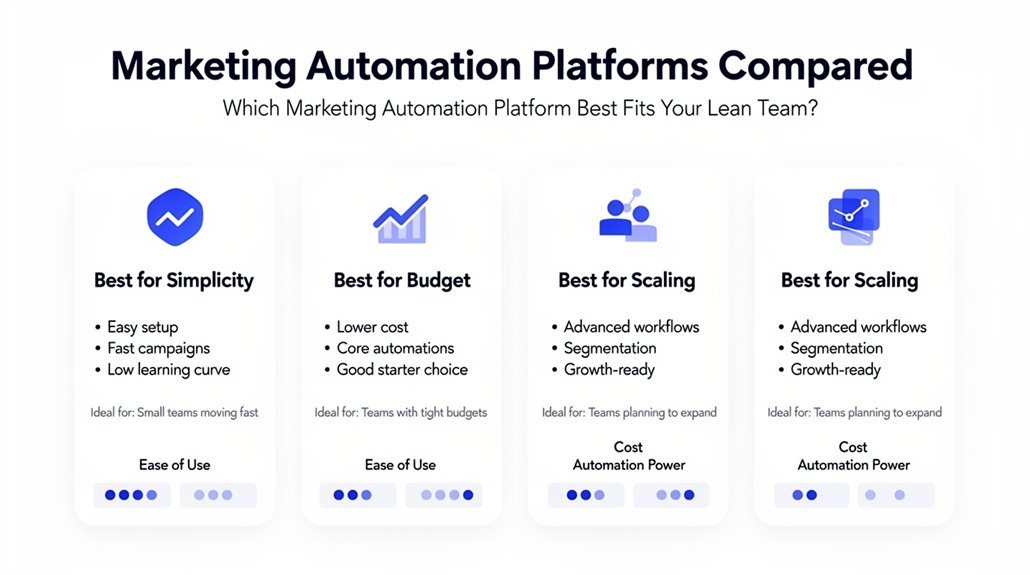
When your marketing team is lean and technical support is limited, selecting the right automation platform means balancing ease of use, affordability, and powerful features. ActiveCampaign stands out as one of the best platforms for lean teams, combining strong email marketing, CRM functionalities, and advanced personalization starting at $29/month. If budget is a priority, Sendinblue’s free plan offers real-time CRM updates and personalized marketing, ideal for small teams. HubSpot’s free tier also delivers solid marketing automation and CRM, perfect for inbound-focused marketers. For ease in collaboration, Autopilot provides drag-and-drop email marketing with collaboration tools on a beginner-friendly plan. If your focus is e-commerce marketing, Drip specializes in workflows and segmentation from just $19/month. Each platform supports automated responses to keep your campaigns efficient. Choosing the platform that aligns with your team’s unique needs guarantees you maximize marketing automation without overstretching resources.
Frequently Asked Questions
What Is the Best Marketing Automation Platform?
The best marketing automation platform helps you master user segmentation strategies and lead nurturing techniques while optimizing your email campaigns through A/B testing methods. You’ll benefit from CRM integration benefits and analytics tracking tools that boost workflow efficiency. Look for content personalization approaches and social media automation features to support multichannel marketing strategies. Choosing such a platform guarantees you streamline your efforts and get the most from your marketing initiatives.
What Are the Top 5 Automation Tools?
The top 5 automation tools you should consider are ActiveCampaign, HubSpot Marketing Hub, Sendinblue, GetResponse, and Mailchimp. They excel in lead nurturing strategies, email campaign optimization, and analytics tracking tools. Each offers strong integration capabilities and user experience design, with cost-effectiveness varying per plan. You’ll find A/B testing, customer segmentation methods, workflow automation features, and support for your continuous improvement process in these platforms, helping you refine campaigns efficiently.
What Are the 5 Marketing Tools?
The 5 marketing tools you’ll want include ones that handle Email Campaigns and Social Media to boost your reach. Look for Lead Generation and Customer Segmentation features to target your audience better. Content Management and SEO Tools help keep your messaging consistent and discoverable. Don’t forget Analytics Reporting and A/B Testing for optimizing performance. Marketing Budgeting and Integration Options guarantee you stay on track financially while connecting with other platforms you use.
Which Two Marketing Platforms?
Between ActiveCampaign vs HubSpot, you’ll want to weigh your priorities. ActiveCampaign shines with user-friendly automation and affordable plans, while HubSpot offers advanced CRM tools but at a much higher cost. Consider Mailchimp features if you need basics, and GetResponse pricing for budget-friendly inbound marketing. Sendinblue templates can save time if you prefer ready-made designs. Each platform offers unique advantages, so align choices with your team’s needs and growth plans.