

AI Marketing Tools for Small Teams: Practical Uses, Limits, and Where to Start
What AI marketing tools can truly transform small teams, and what challenges might slow you down? Discover where to begin for best results.
If you’re part of a small team, you know how juggling marketing tasks can quickly become overwhelming. AI marketing tools offer a chance to automate routine work and sharpen your campaigns without stretching resources thin. Yet, these tools come with their own challenges, from managing data privacy to fitting seamlessly into your workflow. Before you decide which solutions to explore first, it’s important to understand both their practical benefits and potential limitations.
What Are AI Marketing Tools and Why They Matter for Small Teams
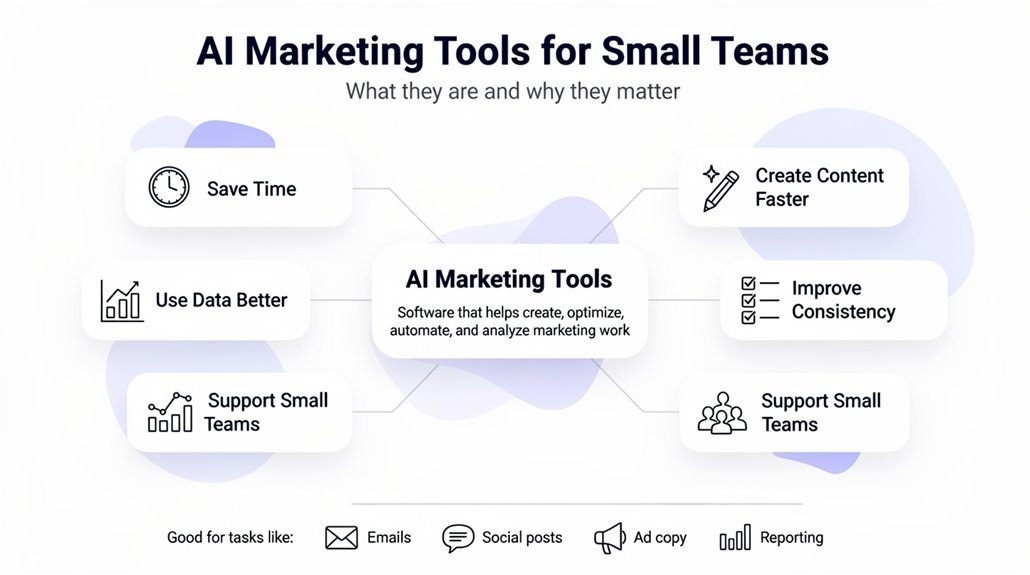
AI marketing tools use machine learning and natural language processing to automate tasks like content creation, SEO, and customer engagement, helping small teams work as efficiently as larger ones. When you leverage these tools, you can automate tasks that once bogged down your schedule, freeing up your time to focus on high-value strategic work. This shift boosts your overall productivity by streamlining marketing efforts without adding more team members. Tools like HubSpot and Salesforce enhance customer engagement through automated lead scoring and follow-ups, helping small teams prioritize high-potential prospects and increase conversions. It’s important you understand compliance as regulations evolve around AI usage, since overlooking legal standards can lead to costly fines. By staying informed and selecting AI marketing tools compatible with your existing systems, you guarantee your small team maximizes effectiveness while remaining compliant. Embracing AI-driven automation for content creation and customer engagement will transform how your small team operates, making your marketing efforts smarter and more efficient.
Starting Smart: How Small Teams Can Use AI Marketing Tools
Getting started with marketing technology doesn’t have to be overwhelming for small teams. You can begin by choosing AI marketing tools that help automate tasks like content creation or email campaigns, freeing your team to focus on strategic initiatives. Start small—consider social media management platforms that offer free tiers, such as Sprout Social, to test features and measure impact without upfront costs. Integrating technology seamlessly into your current workflow is vital; tools like Zapier enable workflow automation without complicating processes. This gradual approach guarantees you build efficiency without added stress. Don’t forget to stay informed about regulatory compliance related to AI tools, which protects your team from legal risks while maximizing marketing advantages. Tools like ActiveCampaign, which starts at just $9/month, offer automated email and revenue attribution features that make scaling accessible even for teams with tight budgets. By prioritizing smart use of these resources, your small team can build a solid foundation in AI-powered marketing that grows with your needs and goals.
AI Models Behind Marketing Tools for Small Teams
You’ll find that five AI models dominate small marketing teams: ChatGPT, Claude, Microsoft Copilot, Gemini, and Perplexity. Each one has its strengths, whether it’s ChatGPT’s versatility or Copilot’s seamless Microsoft integration. Knowing how teams use these models can help you choose the best fit for your specific marketing tasks. Many of these models power tools that combine content creation with analytics to deliver actionable insights that drive stronger marketing decisions.
Major AI Models
While the world of marketing tools is vast, five major AI language models dominate the scene for small teams, collectively making up about 95% of their usage. These models power most AI-driven content creation and productivity in marketing tools for small teams.
- ChatGPT leads with 64.5%, offering versatility in writing, research, and image generation.
- Claude excels at long-form content creation and nuanced reasoning, ideal for complex marketing narratives.
- Microsoft Copilot integrates with Microsoft 365, boosting productivity by handling multi-step tasks seamlessly.
In addition, Gemini is great for quick factual lookups within Google Workspace, while Perplexity focuses on delivering high-quality citations and up-to-date information for competitive market analysis. Knowing these major AI models helps you pick the right marketing tools to fit your small team’s needs.
Model Strengths Comparison
Choosing the right AI model can make a big difference in how effectively your small marketing team works. When doing a model strengths comparison, consider ChatGPT for versatile writing and strong content generation capabilities, as it dominates the market with 64.5% share. Claude shines in long-form writing, making it ideal for detailed tasks. Microsoft Copilot offers seamless integration within the Microsoft 365 suite, boosting workflow efficiency across tools you already use. Gemini supports research-heavy marketing by providing quick factual lookups, while Perplexity excels in citation quality and recent data, essential for competitive research. Selecting the right AI marketing tools based on these strengths guarantees your small team maximizes productivity and content quality without unnecessary complexity.
Usage Patterns In Teams
Since small marketing teams tend to juggle multiple tasks with limited resources, they usually rely on two to three of the five main AI language models—ChatGPT, Claude, Microsoft Copilot, Gemini, and Perplexity—to cover nearly 95% of their AI usage. In the marketing sector, ChatGPT dominates with about 64.5% share, prized for versatile content generation. Claude stands out for long-form writing and reasoning, while Microsoft Copilot enriches user experience by automating repetitive tasks within Microsoft 365.
This usage pattern helps small marketing teams:
- Integrate specialized solutions that boost campaign performance
- Streamline workflows by automating repetitive tasks
- Balance content generation and in-depth analysis with effortless integration
Marketing Tool Applications: Content, Campaigns, and Engagement
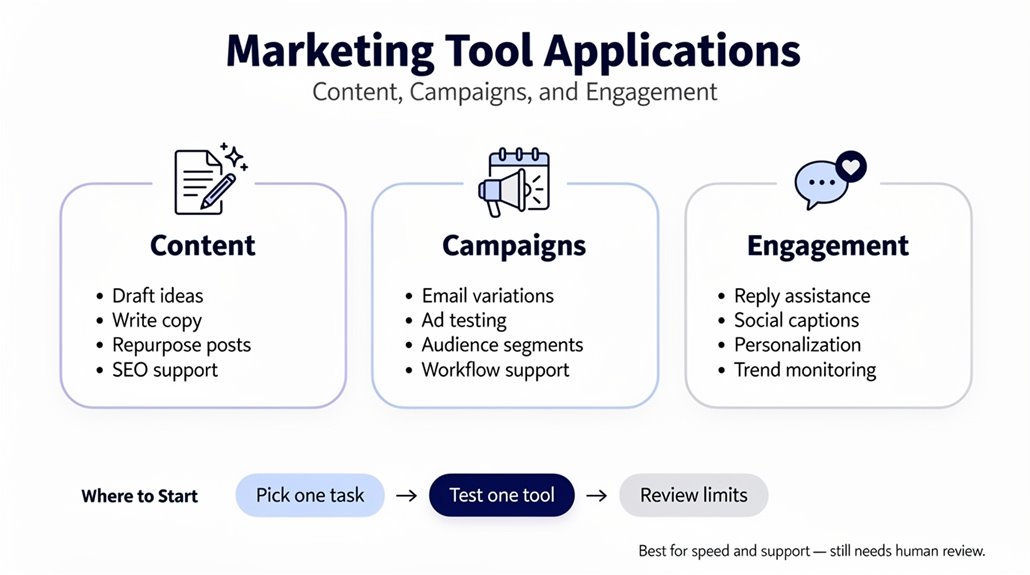
You can save a lot of time creating content with AI tools like Jasper that generate tailored posts and articles for your audience. Automating campaigns through platforms like HubSpot lets you launch and track emails easily, freeing you up to focus on strategy. These efficiencies help small teams run marketing efforts without needing extra hands. For those looking to consolidate even further, platforms like HighLevel offer Content AI and Conversation AI alongside reviews, funnels, and workflow automation all under one flat monthly rate.
Content Creation Efficiency
When small teams need to produce marketing content quickly without sacrificing quality, AI tools like Jasper and HubSpot can be game-changers. These AI marketing tools boost content creation efficiency by generating social media posts, blog content, and email marketing materials aligned with your brand voice. You can even start with free plans to test AI writing capabilities before scaling.
Here’s how AI tools help:
- Create relevant content faster, freeing up time for strategy
- Maintain consistent brand voice across channels
- Improve customer engagement and campaign performance through data-driven insights
Campaign Automation Benefits
Although managing multiple marketing campaigns can quickly become overwhelming, AI tools like HubSpot and Mailchimp automate much of the heavy lifting, freeing your team to focus on strategy instead of repetitive tasks. With campaign automation, small teams can improve efficiency by saving up to 20 hours weekly while ensuring timely content delivery. AI-driven analytics tools in platforms like Sprout Social enable data-driven decision-making, helping you optimize campaigns based on audience behavior and engagement patterns. Additionally, integrating chatbots enhances customer engagement by automating responses, boosting retention and satisfaction. These tools also streamline social media strategies, allowing you to schedule posts and monitor performance effortlessly. By leveraging these AI-powered features, your small team can execute smarter, more effective campaigns without expanding resources.
Identifying Practical AI Use Cases for Small Marketing Teams
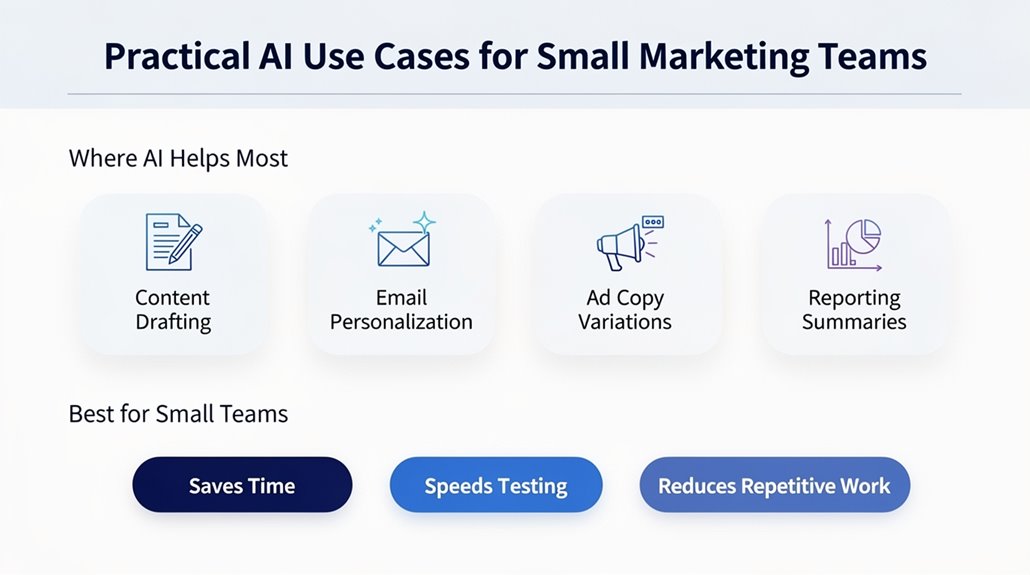
Three key AI use cases can transform how small marketing teams operate by boosting efficiency and impact. By leveraging AI features, you can streamline content creation, automate repetitive tasks, and enhance customer engagement. Smart marketing tools help you track campaign performance and gather customer feedback, allowing data-driven decisions. Platforms like Mailchimp and Brevo offer user-friendly, affordable options that small teams can adopt without requiring advanced technical knowledge.
- Content Creation: Use AI to generate marketing copy and social media posts that maintain your brand voice, saving hours usually spent on drafting.
- Workflow Automation: Automate routine tasks like email marketing and data entry, freeing your team to focus on strategic initiatives.
- Customer Service & Analytics: Employ AI-driven platforms to analyze customer feedback and behavior, helping improve customer service and optimize campaigns.
Choosing AI Marketing Tools for Your Team’s Workflow and Budget
How do you choose the right AI marketing tools without overspending or disrupting your workflow? Start by pinpointing a single use case and look for AI tools that seamlessly integrate AI into your existing tech stack. This boosts efficiency and guarantees smooth workflow automation. For small businesses aiming to limit budget, using free trials is key—they let you test features and customer support before committing to paid plans. Consider tools like HubSpot and Jasper, whose pricing starts affordably. Also, don’t overlook AI chatbots, which can improve engagement without added complexity.
| Tool | Key Benefit |
|---|---|
| HubSpot | Affordable paid plans ($18+) |
| Zapier | Automates workflows ($20+) |
| Jasper | AI content generation ($49+) |
Choosing marketing tools with specific pain points in mind helps you get the most value without financial risk or workflow disruption.
AI Marketing Tool Risks and Limits in 2026
As AI marketing tools become more powerful and widespread in 2026, you’ll need to navigate growing risks and limitations carefully. For small teams, the complexity and evolving technology bring significant challenges. Regulatory scrutiny is intense, meaning compliance isn’t optional—fines for mishandling AI-generated content or data privacy breaches can be severe. Advanced LLMs blend features, making it tough to identify each tool’s unique contributions, which risks underutilization or misguided choices.
Key AI marketing tool risks to watch include:
- Data privacy vulnerabilities, especially with sensitive customer info processed across multiple platforms
- Difficulty differentiating between homogenized AI capabilities, affecting campaign distinctiveness
- Potential reinvestment demand as tools rapidly evolve or become obsolete
To stay effective, you’ll need continuous monitoring of compliance and tech trends, balancing innovation with caution to protect your team and brand.
How AI Improves Customer Engagement and Social Media
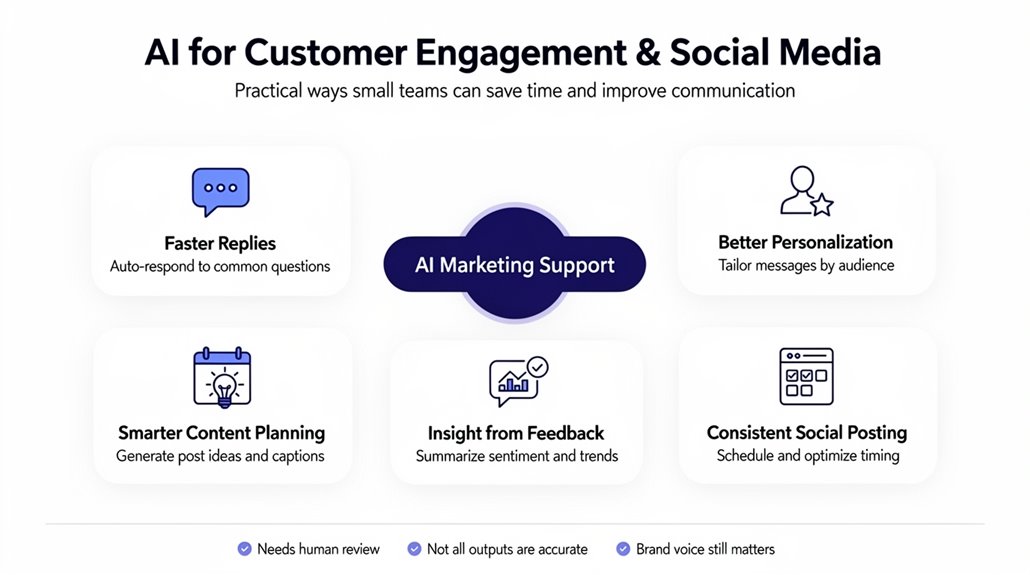
When you integrate AI tools into your marketing strategy, customer engagement and social media management become much more efficient and responsive. AI marketing tools like Intercom Fin automate support, delivering real-time responses that improve service quality and satisfaction. On social media, platforms such as Sprout Social analyze audience behavior to recommend ideal posting times and relevant content, boosting engagement rates. Tools like Brand24 monitor brand sentiment across social media channels, helping you quickly address feedback and strengthen customer relationships. By automating routine tasks, AI frees you to focus on meaningful interactions that deepen connections. Additionally, AI-driven personalization tailors marketing messages based on user preferences, increasing engagement and conversions. Overall, AI enhances how you connect with your audience, making your campaigns more targeted and your social media management smarter and more effective.
Frequently Asked Questions
What Is the 3 3 3 Rule in Marketing?
The 3 3 3 rule in marketing means you focus on three core messages, deliver them in three different ways, and make sure each gets across in three seconds or less. This helps boost brand awareness by grabbing your target audience’s attention quickly. Applying this rule improves user engagement and lead generation across social media and content creation. Plus, it simplifies competitor research, data analysis, and campaign optimization using performance metrics.
What Is the 10 20 70 Rule for AI?
The 10 20 70 rule for AI means you get 10% of your learning from formal AI training on tools like predictive analytics and sentiment analysis. Then, 20% comes from social learning, sharing tips about AI task automation, content generation, or customer segmentation with your team. The biggest chunk, 70%, is hands-on experience—actively using lead scoring, social listening, data visualization, and performance tracking to enhance user experience and master these AI-driven marketing tactics.
Which AI Tool Is Best for Marketing Strategy?
You’ll find HubSpot’s AI Marketing Hub best for marketing strategy since it excels in marketing automation, data analysis, customer segmentation, and performance tracking—all in one. It helps with audience targeting, brand positioning, social media, and email campaigns, giving you a solid AI tool comparison edge. If content generation is your focus, Jasper’s great, while Mailchimp automates email campaigns efficiently. But for overall strategy, HubSpot covers the most bases effectively.
Which Tool Is Commonly Used by AI Teams?
You’ll find that AI teams commonly use ChatGPT because it excels at content generation, email automation, and social media tasks. It integrates well with collaboration platforms, helping streamline customer segmentation and performance metrics tracking. For data analysis and budget allocation, teams often complement ChatGPT with tools like Microsoft Copilot. Using these tools together, you can enhance market research and efficiently respond to user feedback, making your marketing strategies more precise and effective.