
How to Choose the Right Landing Page Builder: Templates, Integrations, Pricing, and Ease of Use
Justifying your landing page builder choice requires balancing templates, integrations, pricing, and ease—discover the secrets to making the best decision today.
Choosing the right landing page builder isn’t just about picking a tool that looks good. You need templates that fit your industry, integrations that sync with your workflow, pricing that won’t break the bank, and an editor that makes customization simple. But with so many options out there, how do you balance these factors to find the one that truly supports your goals? Understanding these key elements can make all the difference.
Should You Use a Landing Page Builder or a Website Builder?
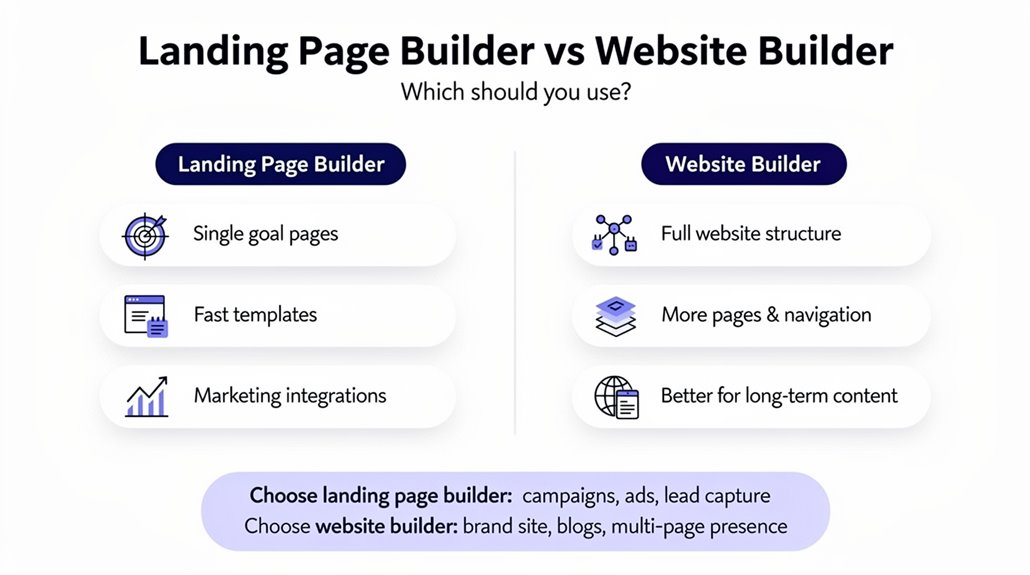
Wondering whether to use a landing page builder or a website builder? If your focus is on creating high-converting landing pages tailored for specific marketing efforts, a landing page builder is your best bet. These tools excel in conversion rate optimization, offering ease of use, A/B testing, and targeted features to boost your campaign’s effectiveness. Their template library and integrations are designed to help you quickly launch focused pages that capture leads.
On the other hand, a website builder supports full website development with multiple pages, giving you more flexibility for long-term content management and business growth. Cost-wise, landing page builders often come with higher monthly fees due to their specialized functions, while website builders can be more budget-friendly for ongoing projects. Ultimately, your choice hinges on whether you want fast deployment of optimized landing pages or a thorough platform for expansive online presence.
Which Landing Page Templates Work Best for Your Goals?
How do you choose the right landing page template to meet your goals? Start by focusing on industry-specific templates, as these are tailored to your niche and proven to boost conversion rates by addressing unique audience needs. Templates with modern styling not only look professional but also build user trust, enhancing user engagement. Look for design flexibility so you can customize elements without sacrificing ease of use, ensuring you create high-converting pages efficiently.
Funnel-style layouts guide visitors smoothly through your desired conversion path, increasing success rates. Dynamic text replacement is a powerful feature that adapts headlines to match user searches, making your messaging more relevant and effective. Don’t overlook regular template updates—they keep your landing pages fresh and aligned with current trends, maintaining peak performance. By choosing landing page templates with these features, you’ll optimize both user engagement and conversion rates while enjoying a seamless building experience.
How to Evaluate Landing Page Builder Integrations
When choosing a landing page builder, you’ll want to contemplate how well it integrates with the tools you already use. Start by evaluating its integrations with essential platforms like your CRM, email marketing platform, and analytics services—this guarantees streamlined data flow and better operational efficiency. Check for pre-built integration options, such as Zapier, which simplify automation and connect multiple tools effortlessly. If you’re selling products directly, verify that payment processing is supported to keep transactions smooth. Also, confirm whether the builder allows easy integration of third-party tracking tools and analytics to monitor user behavior and campaign performance. Since setup processes can vary widely, opt for user-friendly builders that offer straightforward integration setup and solid support documentation. Prioritizing these factors will help you choose a landing page builder that fits seamlessly into your marketing workflow, saving time and boosting efficiency.
Why Ease of Use Matters in Landing Page Builders
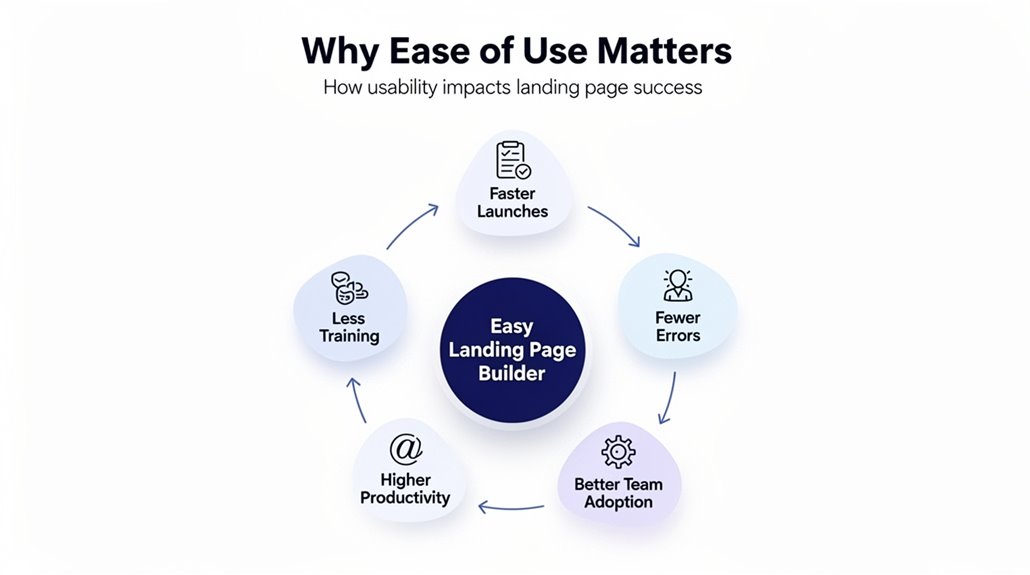
Anyone diving into landing page creation needs a tool that’s easy to use, especially if you’re not tech-savvy. Ease of use is a critical factor in landing page builders because it cuts down the learning curve, letting you craft professional-looking pages quickly with intuitive drag-and-drop editors. You won’t waste time wrestling with complicated interfaces, so you can focus on strategy and campaign goals instead.
User-friendly builders feature optimized workflows that speed up your process and can boost higher conversion rates by reducing bounce rates. Plus, many include A/B testing and analytics within the same platform, supporting data-driven decisions without juggling multiple tools. This integrated, seamless experience helps you launch, test, and tweak pages effortlessly. Choosing a landing page builder that prioritizes ease of use means less frustration, faster deployment, and better campaign performance overall.
How Pricing Plans Affect Your Landing Page Builder Choice
Why does pricing play such an important role in choosing a landing page builder? Because pricing plans directly impact what you can build and achieve. Many builders offer a free plan available, great for testing basic landing pages without upfront costs. However, if you’re running paid ads or seeking real growth, you’ll likely need to upgrade. Top landing page software like Instapage or Leadpages provide tiered pricing models revealing advanced features such as A/B testing and deeper integrations, essential for optimizing your conversion goals.
While some plans let you create unlimited landing pages, others limit pages or traffic, which can restrict your campaigns. Also, cheaper options might lack analytics or CRM integrations, increasing the need for extra tools and costs. It’s important to balance budget with features. Assess how each pricing plan supports your current needs and future growth, ensuring you invest intelligently without overspending or missing key functionalities that can boost your results.
Top Features That Boost Landing Page Conversion Rates
To boost your landing page conversion rates, you’ll want to focus on optimized calls-to-action that guide visitors clearly toward the next step. Responsive mobile design is a must since most traffic comes from mobile devices, ensuring your page looks great everywhere. Plus, A/B testing features let you experiment with different elements to find what works best for your audience.
Optimized Call-To-Actions
Three key strategies can dramatically improve how your landing page converts: clear placement, striking design, and personalized messaging for your Calls-to-Action (CTAs). Optimized call-to-actions placed above the fold can increase conversions by up to 28%. Using contrasting colors makes CTAs 21% more likely to be clicked, grabbing visitor attention. Personalized CTAs tailored to user behavior boost conversion rates by as much as 42%, enhancing user engagement. A/B testing your CTAs’ wording and design uncovers variations that can raise click-through rates by over 50%. Plus, ensuring CTAs are mobile-friendly and easy to use improves action rates, as 67% of mobile users respond well to smooth experiences. By focusing on these elements, you create effective landing pages that convert consistently.
Responsive Mobile Design
Although desktop browsing remains common, mobile users make up over 54% of total web traffic, so your landing page needs to perform flawlessly on all devices. Responsive mobile design guarantees your mobile pages load quickly—ideally under 3 seconds—to prevent high bounce rates. Incorporating AMP landing pages can boost conversion rates by 20% thanks to faster load times. To enhance user experience, use clear, touch-friendly buttons and simplified navigation, which can increase conversions by 162%. Mobile optimization isn’t just about speed; it’s about intuitive design that keeps visitors engaged. Leveraging A/B testing for mobile-specific layouts uncovers valuable data-driven improvements, helping you optimize your landing pages for even higher conversion rates. Prioritize responsive design to make the most of your mobile traffic and drive better results.
A/B Testing Features
The performance and design of your landing page aren’t just about how it looks on different devices—they’re also about what actually drives your visitors to take action. That’s where a/b testing comes in. Many landing page builders available today, like Unbounce and Instapage, offer powerful a/b testing or split testing features that let you compare different headlines, images, or call-to-action buttons. These advanced marketing features help you create high-converting pages by tracking detailed metrics on user engagement and conversion rates. By changing one element at a time, you can accurately identify what helps you capture leads and satisfy multiple client needs. Incorporating a/b testing guarantees your landing pages evolve based on real data, boosting ROI and turning visitors into customers.
Customization Options to Make Your Landing Pages Pop
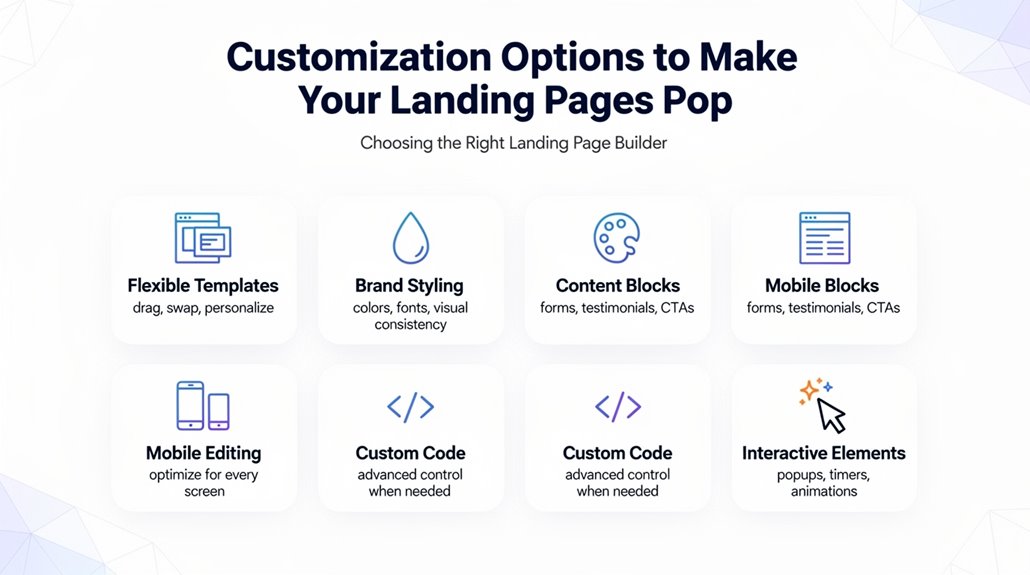
Customization is what lets your landing pages truly reflect your brand and message. With the right customization options, landing page builders give you the tools to craft pages that stand out without requiring coding skills. Here’s what to look for:
- Drag-and-drop editors let you easily modify templates, creating a fast, user-friendly design process.
- Advanced features like Webflow’s visual CSS editor offer deep control for unique, polished pages.
- Smart Sections help maintain brand consistency by reusing design elements efficiently across pages.
- AI Text Assistant tools craft compelling, targeted copy to boost engagement and conversion.
Keep in mind, pricing tiers often determine access to personalized design options and A/B testing, letting you experiment for the best results. Choosing a builder with robust customization options guarantees your landing pages not only look great but also work effectively to convert visitors.
How AI Tools Can Help: And When They Fall Short
You’ll find AI tools helpful for quickly enhancing your landing page text and making simple design tweaks. However, these tools often fall short when you need deeper customization or content tailored to complex business goals. For serious launches, relying solely on AI isn’t enough—you’ll want a builder with more advanced features and analytics.
AI Text Enhancement
AI text enhancement tools can speed up your copywriting by fine-tuning headlines and content with quick, targeted tweaks. Many landing page builders now feature AI tools that generate tailored text, simplifying the copywriting process. Here’s how AI text enhancement can help:
- Quick headline adjustments to grab attention.
- Creation of targeted text tailored to your audience.
- Streamlined content optimization by suggesting improvements.
- Easy integration within landing page builders.
However, while these tools boost efficiency, complex marketing materials often need human input for emotional depth and nuance. AI-driven analytics in these tools may also fall short, offering limited data for strategic content optimization. So, use AI text enhancement to speed up routine tasks but complement it with human creativity for your most important marketing materials.
Limitations Of AI
Although AI tools in landing page builders can speed up content creation with quick tweaks and suggestions, they often fall short when you need truly custom messaging or detailed analytics. AI typically offers minor text or image adjustments but struggles to generate content that meets unique marketing teams’ goals. Its limitations are clear when it comes to deeper integrations and advanced features essential for performance optimization. If your user expectations include crafting high-converting landing pages with nuanced strategies, relying solely on AI may disappoint. While AI can assist in streamlining parts of your workflow, a dedicated landing page builder with robust features will better support your objectives, delivering the tailored insights and seamless integrations necessary for effective marketing campaigns.
Business Needs Beyond AI
When building landing pages, relying solely on automated tools can leave gaps in messaging and strategy. While an AI landing page builder offers ease of use and ready-made templates, it often falls short for businesses with complex needs. To truly meet your business needs beyond AI, consider these points:
- Custom landing pages require human insight to create unique messaging that AI can’t fully craft.
- Robust analytics are essential to track performance—many AI tools lack thorough tracking.
- Integrations with marketing tools guarantee seamless workflows and accurate data sharing.
- Pricing should reflect features beyond basic AI tweaks, including access to expert support and advanced marketing capabilities.
Balancing AI with human-driven design and strategy leads to better results than AI alone.
Frequently Asked Questions
Can I Use a Landing Page Builder Without Prior Coding Knowledge?
Yes, you can definitely use a landing page builder without prior coding knowledge. Most popular platforms offer drag and drop functionality and pre-designed templates, making customization options easy and user-friendly. These builders enhance user experience with integration possibilities, performance analytics, and SEO capabilities. Plus, customer support and learning resources guide you through the process, ensuring you can create effective landing pages without needing to code.
How Secure Are the Landing Page Builders for Customer Data?
Landing page builders are generally secure for your customer data, thanks to data encryption, SSL certificates, and strict access controls. Most follow compliance standards like GDPR to protect user privacy. They perform regular security audits and data backups, which help prevent fraud and data loss. When choosing one, check how they handle third party integrations and what customer support they offer for security issues. Always verify your builder prioritizes these security features for peace of mind.
Do Landing Page Builders Support A/B Testing Natively?
Yes, many landing page builders support A/B testing natively, letting you create testing variations easily. This helps you optimize conversion by improving user experience and tailoring designs with flexibility. Built-in analytics tools track performance metrics, so you can analyze traffic sources and segment your audience effectively. Using these insights boosts lead generation, ensuring your campaigns perform better by identifying what resonates most with your visitors.
Can Landing Pages Created Be Easily Transferred Between Platforms?
You can’t usually transfer landing pages easily between platforms due to transfer limits and compatibility checks. While some builders offer importing designs and exporting workflows, maintaining design consistency and asset management can be tricky. Platform flexibility and template portability vary, so it’s essential to review migration tools and user access options beforehand. If you plan to switch often, pick a builder known for smoother asset transfers and flexible migration support.
Are There Mobile-Specific Features in Landing Page Builders?
Yes, many landing page builders include mobile-specific features like responsive design and mobile optimization, ensuring your pages look great on any device. You’ll find touch gestures support, click to call, SMS integration, and mobile pop ups to boost engagement. Features like AMP compatibility improve page load speed, while mobile analytics and geolocation targeting help you track and target mobile users effectively. These tools make your landing pages more powerful on smartphones and tablets.